TEXT
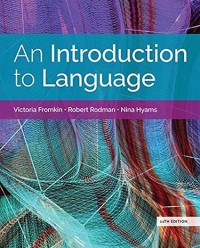
An Introduction to Language
Content notes
1. What is language? Linguistic knowledge ; What is grammar? ; What is not (human) language ; Language and thought -- 2. Morphology : the words of language. Content words and function words ; Morphemes : the minimal units of meaning ; Rules of word formation ; Morphological analysis : identifying morphemes -- 3. Syntax : infinite use of finite means. What the syntax rules do ; Sentence structure ; The internal structure of phrases ; Grammatical dependencies -- 4. The meaning of language. What speakers know about sentence meaning ; Compositional semantics ; When compositionality goes awry ; Lexical semantics (word meanings) ; Pragmatics -- 5. Phonetics : the sounds of language. Sound segments ; The phonetic alphabet ; Articulatory phonetics ; Major phonetic classes ; Prosodic features ; Phonetic symbols and spelling correspondences ; The "phonetics" of signed languages -- 6. Phonology : the sound patterns of language. The pronunciation of morphemes ; Phonemes : the phonological units of language ; The rules of phonology ; Prosodic phonology ; Sequential constraints of phonemes ; Why do phonological rules exist? ; Phonological analysis -- 7. Language in society. Dialects ; Languages in contact ; Language and education ; Language in use -- 8. Language change : the syllables of time. The regularity of sound change ; Phonological change ; Morphological change ; Syntactic change ; Lexical change ; Extinct and endangered languages ; The genetic classification of languages ; Types of languages ; Why do languages change? ; The history of writing -- 9. Language acquisition. The linguistic capacity of children ; The role of the linguistic environment: adult input ; Knowing more than one language -- 10. Language processing and the human brain. The human mind at work ; Brain and language ; Language and brain development ; The modular mind : dissociations of language and cognition -- Glossary
Ketersediaan
Informasi Detail
- Judul Seri
-
-
- No. Panggil
-
410 VIC
- Penerbit
- USA : Cengage Learning, Inc.., 2017
- Deskripsi Fisik
-
xx, 524 halaman : illustrasi, peta ; 24 cm
- Bahasa
-
English
- ISBN/ISSN
-
978-1337559577
- Klasifikasi
-
410
- Tipe Isi
-
text
- Tipe Media
-
tanpa perantara (unmediated)
- Tipe Pembawa
-
volume
- Edisi
-
11
- Subjek
- Info Detail Spesifik
-
-
- Pernyataan Tanggungjawab
-
Prof. Dr. Victoria Fromkin, Prof. Robert Rodman, Ph.D., Prof. Nina Hyams, Ph.D.
Versi lain/terkait
Tidak tersedia versi lain
Lampiran Berkas
Komentar
Anda harus masuk sebelum memberikan komentar
 Karya Umum
  Filsafat
  Agama
Agama  Ilmu-ilmu Sosial
  Bahasa
  Ilmu-ilmu Murni
  Ilmu-ilmu Terapan
  Kesenian, Hiburan, dan Olahraga
  Kesusastraan
  Geografi dan Sejarah